Mechanism Design • Linkages • Prototyping

Walking Table

Passion project, Strandbeest-inspired walking table using linkage-based legs to generate smooth, stable motion, with integrated motors.

Mechanisms SolidWorks 3D Printing Arduino Circuits Design for Assembly

Project Overview

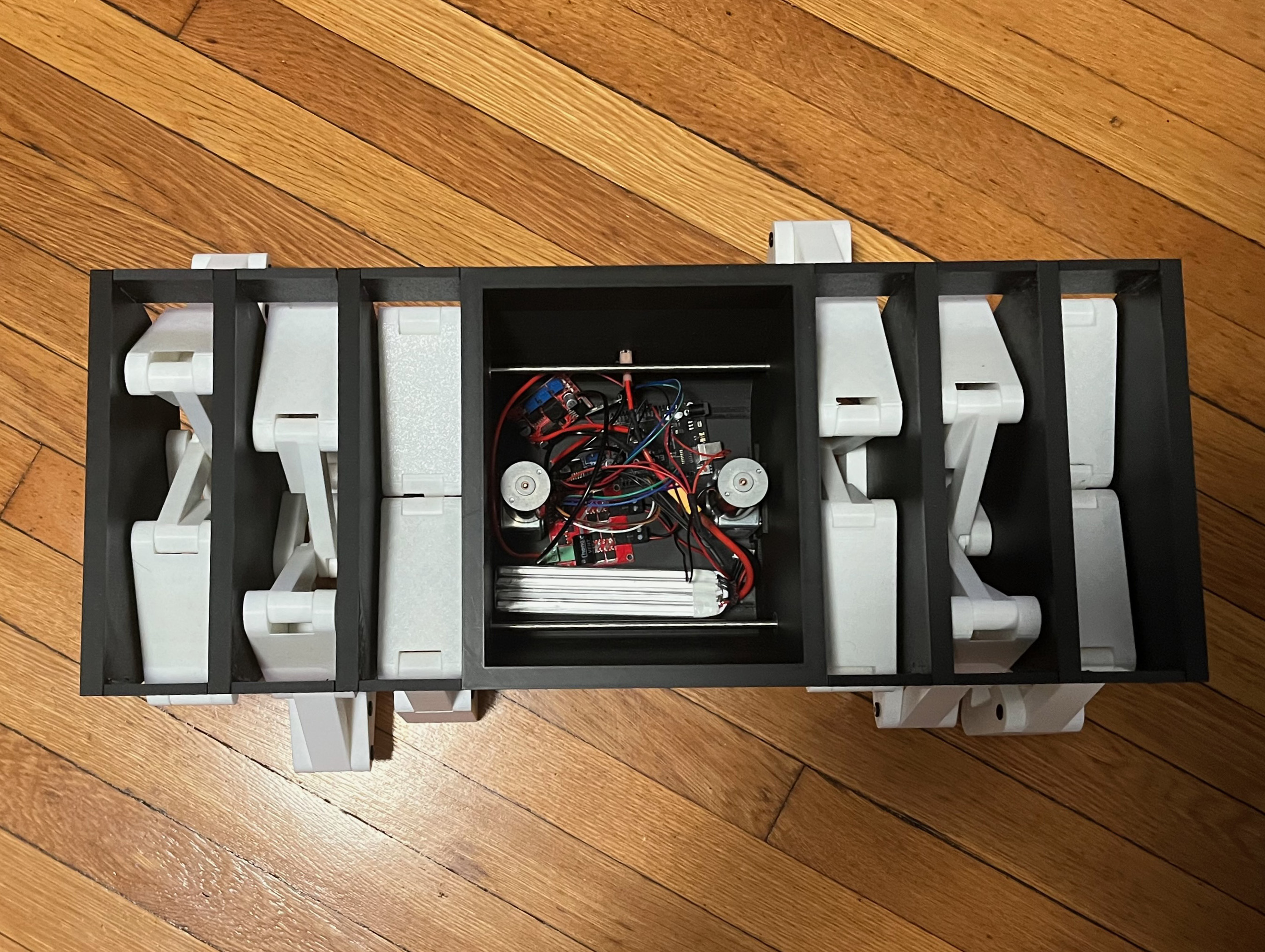
Strandbeest-inspired walking table using multi-linkage legs for smooth, stable motion. Driven by a tank-style motor system for controlled movement and steering. All components were 3D printed, with bearings and fasteners enabling low-friction linkage motion. The system is controlled via a Bluetooth joystick for real-time operation
What I Worked On

  • Designed leg components, enclosure plates, and multi-linkage connectors in SolidWorks for 3D printing.
  • Specified mechanical and electrical components for structure, motion, and voltage requirements.
  • Built the circuit for a dual-motor system with battery power and wireless control.
  • Developed Arduino code for forward, reverse, and stearing.

From CAD to Build

This stage of the project focused on translating the digital design into a functional physical system. Each component had to be designed with both motion constraints and manufacturability in mind.

The interaction between parts was critical, especially in maintaining smooth linkage motion and ensuring structural stability. Iterating between CAD and physical assembly helped refine tolerances and improve overall performance.

Mechanical Design

Component Highlights

Previous image preview Main slider image Next image preview

Parts

Components were selected for structural strength and smooth rotation, using fasteners with bearings. Threaded inserts were used for reliable assembly in 3D printed parts.

Previous image preview Main slider image Next image preview

Leg linkages

The linkage system converts circular cranker input into smooth, stable walking motion through a multi-link mechanism.

Previous image preview Main slider image Next image preview

Enclosure

The enclosure and plates form the structural frame, supporting the linkage system and maintaining alignment during motion.

Electronic Design

Wiring Highlights

Previous image preview
Next image preview

Wire Prototype

A lithium battery powers the motors through a driver and buck-boost converter, while a separate 9V supply powers the Arduino Nano and joystick controller.

End cap components

Enclosed Electronics

The circuit was soldered and integrated into the enclosure for protection, organization, and reliable operation.

Linkage Motion in Action

This section shows the walking mechanism in both the physical build and CAD, illustrating how rotational input is transferred through the linkage system to produce walking stability.

The design is based on Strandbeest-inspired geometry, where each leg follows a repeatable path to maintain smooth forward motion. Three legs on each side allows continous ground contact.

What I Learned & Future Improvements

This project improved my ability to plan a system starting from electronics and integrate supporting mechanical components. I refined linkage design and learned how print orientation and layer direction impact strength in 3D printed parts. Moving forward, I would focus more on cost-driven design. The system included over 570 parts, highlighting the importance of budgeting and part count reduction.

Contact Me

Feel free to reach out for projects, collaboration, or opportunities.